
Syllabus
What IB DP covers
Analysis & Approaches (AA): 5 Topics
- Number & Algebra: sequences, exponents/logs, proof; HL adds complex numbers, induction and partial fractions
- Functions: quadratics, transformations, composite functions; HL adds polynomial and rational functions
- Geometry & Trigonometry: 3D geometry, radians, the unit circle; HL adds vectors and compound-angle identities
- Statistics & Probability: sampling, regression, binomial/normal distributions; HL adds Bayes' theorem
- Calculus: limits, derivative rules, integration; HL adds implicit differentiation, substitution and Maclaurin series
Applications & Interpretation (AI): 5 Topics
- Number & Algebra: financial applications, technology-based equation solving; HL adds matrices and complex numbers
- Functions: modelling with linear, exponential, cubic and sinusoidal functions; HL adds further modelling and log scales
- Geometry & Trigonometry: Voronoi diagrams, applied trigonometry; HL adds matrix transformations and graph theory
- Statistics & Probability: hypothesis testing, Spearman's rank; HL adds confidence intervals and Markov chains
- Calculus: optimisation in context, the trapezoidal rule; HL adds differential equations, slope fields and Euler's method
Study Notes
IB DP notes from our tutors
IB DP Mathematics
9 sections · 8 notes
- Arithmetic and Geometric Sequences
- Finite Arithmetic and Geometric Series
- Exponential Models and Logarithms
- Coordinate Geometry and Distance · Locked, notes not yet available
- Radians and Circle Measures · Locked, notes not yet available
- Trigonometric Ratios and Identities · Locked, notes not yet available
- Sine and Cosine Rules · Locked, notes not yet available
- Geometry and Trigonometry Review · Locked, notes not yet available
- Polynomial and Rational Functions · Locked, notes not yet available
- Equations and Inequalities · Locked, notes not yet available
- Function Models and Interpretation · Locked, notes not yet available
- Algebra and Functions Review · Locked, notes not yet available
- Data Collection and Sampling · Locked, notes not yet available
- Measures of Centre and Spread · Locked, notes not yet available
- Statistical Diagrams · Locked, notes not yet available
- Correlation and Regression · Locked, notes not yet available
- Statistics Review · Locked, notes not yet available
- Probability Rules and Conditional Probability · Locked, notes not yet available
- Discrete Random Variables · Locked, notes not yet available
- Binomial Distribution · Locked, notes not yet available
- Normal Distribution · Locked, notes not yet available
- Probability Review · Locked, notes not yet available
- Limits and Rates of Change · Locked, notes not yet available
- Differentiation Rules · Locked, notes not yet available
- Tangents and Optimisation · Locked, notes not yet available
- Integration and Area · Locked, notes not yet available
- Calculus Review · Locked, notes not yet available
- Proof and Mathematical Induction · Locked, notes not yet available
- Complex Numbers · Locked, notes not yet available
- Vectors Lines and Planes · Locked, notes not yet available
- Further Trigonometric Methods · Locked, notes not yet available
- Further Calculus and Differential Equations · Locked, notes not yet available
- AA Extension Review · Locked, notes not yet available
- Financial Models · Locked, notes not yet available
- Matrices and Transformations · Locked, notes not yet available
- Graphs and Networks · Locked, notes not yet available
- Statistical Inference · Locked, notes not yet available
- Numerical Methods and Differential Equations · Locked, notes not yet available
- AI Extension Review · Locked, notes not yet available
Exam Pattern
How IB DP is assessed
Paper 1
No calculator for AA; GDC required throughout for AI. Compulsory short- and extended-response questions.
Paper 2
Calculator (GDC) required for both AA and AI.
Paper 3 (HL only)
GDC required; only sat by Higher Level students.
Internal Assessment
A 10–15 hour written mathematical exploration on a student-chosen topic, assessed against 5 IA-specific criteria.
Required Materials
What you'll need
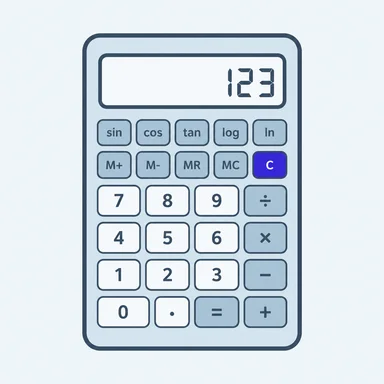
IB-approved GDC
A graphic display calculator such as the TI-84 Plus CE, TI-Nspire CX or Casio fx-9750/fx-CG50.
Official formula booklet
A clean copy of the AA or AI formula booklet is provided in every exam. Practice with it, since an annotated copy isn't allowed.
Oxford or Haese Mathematics AA/AI
The two officially endorsed textbook series, published separately for AA and AI, each in SL and HL editions.
Try It Yourself
Sample questions, solved step by step
Scroll into view to watch each solution build itself, one step at a time, exactly how our tutors walk students through it.
Sample question
Solve for x > 0: log₃(x) + log₃(x − 2) = 1.
Animated solution
Combine the logs
Using the product rule, log₃(x) + log₃(x − 2) = log₃[x(x − 2)]
Rewrite in exponential form
log₃[x(x − 2)] = 1 means x(x − 2) = 3¹ = 3
Solve the quadratic
x² − 2x − 3 = 0 → (x − 3)(x + 1) = 0 → x = 3 or x = −1
Check the domain
x = −1 is rejected (log of a negative number is undefined); x = 3 gives x − 2 = 1 > 0, which is valid
Answer: x = 3
Sample question
A town's population is modelled by P(t) = 12000(1.03)ᵗ, where t is years after 2020. Find the year the population first exceeds 18,000.
Animated solution
Set up the inequality
12000(1.03)ᵗ > 18000
Isolate the exponential term
Divide both sides by 12000: 1.03ᵗ > 1.5
Take logarithms of both sides
t · ln(1.03) > ln(1.5), so t > ln(1.5) / ln(1.03)
Compute
t > 0.4055 / 0.02956 ≈ 13.7 years after 2020
Answer: During 2034 (t ≈ 13.7 years after 2020)