
Syllabus
What AP covers
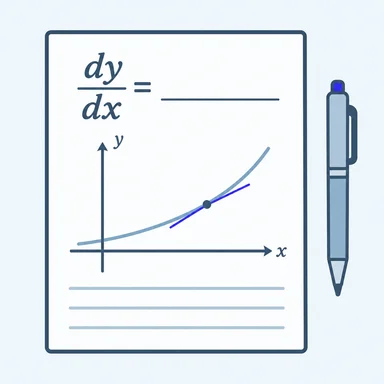
AP Calculus AB (8 Units)
- Unit 1 (Limits and Continuity): limit laws, one/two-sided limits, discontinuities, the Intermediate Value Theorem
- Unit 2 (Differentiation: Definition and Fundamental Properties): the difference quotient, power/product/quotient rules, derivatives of trig, exponential and log functions
- Unit 3 (Differentiation: Composite, Implicit and Inverse Functions): the chain rule, implicit differentiation, inverse and inverse trig derivatives
- Unit 4 (Contextual Applications of Differentiation): related rates, linear approximation, L'Hôpital's rule, motion
- Unit 5 (Analytical Applications of Differentiation): the Mean Value Theorem, extrema, concavity, optimization
- Unit 6 (Integration and Accumulation of Change): Riemann sums, the Fundamental Theorem of Calculus, u-substitution
- Unit 7 (Differential Equations): slope fields, separable equations, exponential growth and decay
- Unit 8 (Applications of Integration): area between curves, volumes by disk/washer, average value of a function
AP Calculus BC (10 Units)
- Units 1–8: all AP Calculus AB content above, assessed with different weightings
- Unit 9 (Parametric, Polar and Vector-Valued Functions): differentiating/integrating parametric and vector functions, arc length, motion via vectors, area of polar regions
- Unit 10 (Infinite Sequences and Series): convergence tests, power series, Taylor and Maclaurin series, the Lagrange error bound
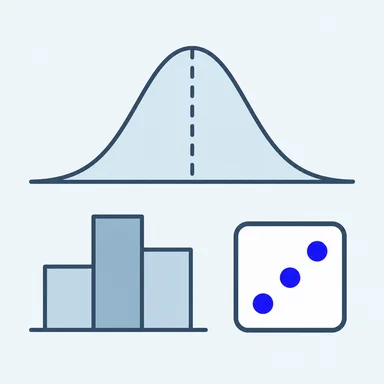
AP Statistics (9 Units)
- Unit 1 (Exploring One-Variable Data): shape, center, spread, z-scores, the normal distribution
- Unit 2 (Exploring Two-Variable Data): scatterplots, correlation, least-squares regression, residuals
- Unit 3 (Collecting Data): sampling methods, bias, experimental design
- Unit 4 (Probability, Random Variables and Probability Distributions): probability rules, binomial and geometric distributions
- Unit 5 (Sampling Distributions): the Central Limit Theorem, standard error
- Units 6–7 (Inference for Categorical and Quantitative Data): confidence intervals and significance tests for proportions and means
- Units 8–9 (Chi-Square Tests and Inference for Slopes): goodness-of-fit/independence tests and inference for a regression slope
Study Notes
AP notes from our tutors
AP Precalculus
9 sections · 80 notes
- Arithmetic and Geometric Sequences · Locked, notes not yet available
- Exponential Change and Growth Factors · Locked, notes not yet available
- Exponential Function Models · Locked, notes not yet available
- Competing Exponential Models · Locked, notes not yet available
- Exponential and Sequence Models Review · Locked, notes not yet available
- Parametric Functions
- Parametric Functions Modeling Planar Motion
- Parametric Functions and Rates of Change
AP Calculus
11 sections · 14 notes
- Derivatives of Inverse Functions · Locked, notes not yet available
- Exponential and Logarithmic Derivatives · Locked, notes not yet available
- Higher Derivatives · Locked, notes not yet available
- Related Rates · Locked, notes not yet available
- Linear Approximation · Locked, notes not yet available
- Derivative Applications Review · Locked, notes not yet available
- The Mean Value Theorem · Locked, notes not yet available
- Increasing and Decreasing Functions · Locked, notes not yet available
- Concavity and Inflection Points · Locked, notes not yet available
- Optimisation · Locked, notes not yet available
- L Hopital Rule · Locked, notes not yet available
- Analytical Applications Review · Locked, notes not yet available
- Antiderivatives and Initial Conditions · Locked, notes not yet available
- Riemann Sums · Locked, notes not yet available
- Definite Integrals · Locked, notes not yet available
- The Fundamental Theorem of Calculus · Locked, notes not yet available
- Integration by Substitution · Locked, notes not yet available
- Integration Review · Locked, notes not yet available
- Slope Fields · Locked, notes not yet available
- Separable Differential Equations · Locked, notes not yet available
- Exponential Growth and Decay · Locked, notes not yet available
- Differential Equations Review · Locked, notes not yet available
- Area Between Curves · Locked, notes not yet available
- Volumes by Disks and Washers · Locked, notes not yet available
- Volumes by Cross Sections · Locked, notes not yet available
- Average Value and Motion · Locked, notes not yet available
- Applications of Integration Review · Locked, notes not yet available
- Integration by Parts · Locked, notes not yet available
- Partial Fractions · Locked, notes not yet available
- Improper Integrals · Locked, notes not yet available
- Euler Method and Logistic Models · Locked, notes not yet available
- Advanced Integration Review · Locked, notes not yet available
- Parametric Derivatives and Arc Length · Locked, notes not yet available
- Polar Curves and Area · Locked, notes not yet available
- Vector Valued Motion · Locked, notes not yet available
- Parametric Polar and Vector Review · Locked, notes not yet available
- Convergence of Sequences and Series · Locked, notes not yet available
- Tests for Series Convergence · Locked, notes not yet available
- Alternating Series and Error Bounds · Locked, notes not yet available
- Power Series · Locked, notes not yet available
- Taylor and Maclaurin Series · Locked, notes not yet available
- Series Review · Locked, notes not yet available
Exam Pattern
How AP is assessed
AP Calculus AB
30 MCQ (60 min, no calculator) + 15 MCQ (45 min, calculator required). 2 FRQ (30 min, calculator) + 4 FRQ (60 min, no calculator). MCQ and FRQ are each worth 50%.
AP Calculus BC
Same structure as Calculus AB, but content spans limits through infinite series. BC students also receive a separate AB subscore from the AB-equivalent portion.
AP Statistics
40 MCQ (1h30m) then 5 free-response questions plus 1 investigative task (1h30m), each section worth 50%. A built-in Desmos calculator and a formula sheet are provided.
Required Materials
What you'll need
AP Classroom
The official College Board platform for Progress Checks, unit exams and personalized practice, granted through your teacher.
Course and Exam Description (CED)
The free official PDF listing every examinable unit, skill and weighting for AB, BC and Statistics.
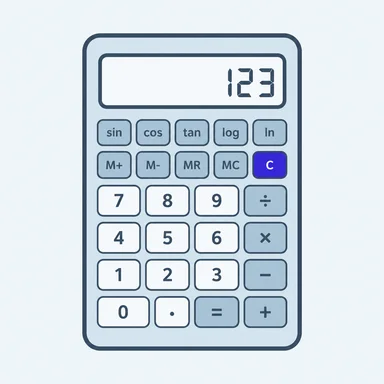
Graphing calculator
TI-84 Plus (CE), TI-Nspire CX/CAS, Casio fx-9750/9860GII or HP Prime are all approved, including full CAS models.
Released free-response questions
Past FRQs and official scoring guidelines on AP Central, the best way to learn the exact rubric language graders look for.
Try It Yourself
Sample questions, solved step by step
Scroll into view to watch each solution build itself, one step at a time, exactly how our tutors walk students through it.
Sample question
Find the absolute maximum value of f(x) = x³ − 6x² + 9x + 1 on the interval [0, 5].
Animated solution
Find critical points
f'(x) = 3x² − 12x + 9 = 3(x − 1)(x − 3), so x = 1 and x = 3
Evaluate f at critical points and endpoints
f(0) = 1, f(1) = 5, f(3) = 1, f(5) = 21
Compare all values
The largest value among 1, 5, 1 and 21 is 21, occurring at x = 5
Answer: 21 (at x = 5)
Sample question
A binomial random variable X has n = 10 trials and success probability p = 0.3. Find P(X = 3).
Animated solution
Identify the parameters
n = 10, p = 0.3, k = 3
Compute the binomial coefficient
C(10, 3) = 120
Compute the probability factor
(0.3)³ × (0.7)⁷ ≈ 0.027 × 0.08235 ≈ 0.002264
Multiply
P(X = 3) = 120 × 0.002264 ≈ 0.2668
Answer: ≈ 0.267