
Syllabus
What AMC covers
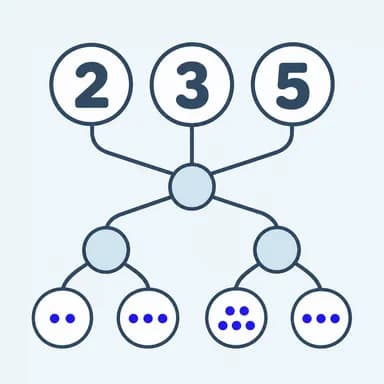
AMC 8
- Arithmetic, estimation and ratio/proportion
- Elementary geometry: the Pythagorean theorem, area and perimeter
- Basic number theory and counting
- Reading graphs, tables and spatial visualization
AMC 10
- Elementary algebra: linear and quadratic equations, systems, sequences
- Geometry: triangles, circles, polygons, area/volume and coordinate geometry
- Elementary number theory: divisibility, primes, modular arithmetic basics, GCD/LCM
- Elementary combinatorics and probability (no trigonometry, logarithms or complex numbers)
AMC 12 (adds to AMC 10)
- Trigonometry: the six trig functions, unit circle, law of sines/cosines
- Complex numbers and the complex plane
- Logarithms and exponential functions
- Polynomial theory, including Vieta's formulas, and deeper combinatorics/probability
Study Notes
AMC notes from our tutors
AMC
4 sections · 0 notes
- Arithmetic Ratios and Percentages · Locked, notes not yet available
- Divisibility Primes and Remainders · Locked, notes not yet available
- Counting and Elementary Probability · Locked, notes not yet available
- Angles Area and the Pythagorean Theorem · Locked, notes not yet available
- Patterns and Logical Problem Solving · Locked, notes not yet available
- AMC 8 Review · Locked, notes not yet available
- Algebraic Identities and Equations · Locked, notes not yet available
- Functions Sequences and Quadratics · Locked, notes not yet available
- Number Theory and Modular Arithmetic · Locked, notes not yet available
- Counting with Cases and Complements · Locked, notes not yet available
- Probability and Expected Counts · Locked, notes not yet available
- AMC 10 Algebra and Counting Review · Locked, notes not yet available
- Triangles Similarity and Area · Locked, notes not yet available
- Circles and Polygons · Locked, notes not yet available
- Coordinate Geometry · Locked, notes not yet available
- Geometry Problem Solving Review · Locked, notes not yet available
- Trigonometric Identities and Equations · Locked, notes not yet available
- Complex Numbers · Locked, notes not yet available
- Logarithms and Exponentials · Locked, notes not yet available
- Polynomial Roots and Vieta Relations · Locked, notes not yet available
- Advanced Counting and Probability · Locked, notes not yet available
- AMC 12 Review · Locked, notes not yet available
Exam Pattern
How AMC is assessed
AMC 8
Integer answers from 0–25, no calculator, 1 point per correct answer, max score 25.
AMC 10 / AMC 12
Multiple choice with 5 options, no calculator. 6 points per correct answer, 1.5 points per blank, 0 for incorrect; max score 150.
Qualification pathway
Top ~2.5% of AMC 10 and top ~5% of AMC 12 scorers are invited to the AIME; exact cutoffs are announced fresh each year.
Required Materials
What you'll need
Official past AMC papers
Freely published by the MAA with full solutions, the single best source of realistic practice.
Art of Problem Solving (AoPS) texts
Introduction to Algebra, Geometry, Number Theory and Counting & Probability are the de facto standard prep books.
AoPS Alcumus
A free adaptive practice platform that targets exactly the topics an AMC student is weakest on.
Try It Yourself
Sample questions, solved step by step
Scroll into view to watch each solution build itself, one step at a time, exactly how our tutors walk students through it.
Sample question
How many positive integers less than 1000 are divisible by neither 5 nor 7?
Animated solution
Count multiples of 5
⌊999/5⌋ = 199
Count multiples of 7
⌊999/7⌋ = 142
Count multiples of both (35), to avoid double-counting
⌊999/35⌋ = 28
Apply inclusion-exclusion, then subtract
Multiples of 5 or 7 = 199 + 142 − 28 = 313. So 999 − 313 = 686
Answer: 686
Sample question
If z is a complex number such that z + 1/z = 1, find z¹⁰⁰ + 1/z¹⁰⁰.
Animated solution
Find z
z + 1/z = 1 → z² − z + 1 = 0, whose roots are the primitive 6th roots of unity: z = e^(±iπ/3)
Use the period
Since z⁶ = 1, powers of z repeat every 6 steps; 100 mod 6 = 4
Reduce the exponent
z¹⁰⁰ = z⁴ = e^(i4π/3), and since |z| = 1, z¹⁰⁰ + 1/z¹⁰⁰ = 2cos(4π/3)
Evaluate
cos(4π/3) = −1/2, so the expression = 2 × (−1/2) = −1
Answer: −1